
Benefits of Custom Software Development

Custom software development is becoming a game-changer for businesses across industries, offering tailored solutions that drive efficiency, scalability, and long-term growth. Unlike generic off-the-shelf products, custom applications align directly with your business goals and workflows. This article explores the top benefits of custom software development, real-world case studies, and common mistakes to avoid so your business can unlock its full potential.
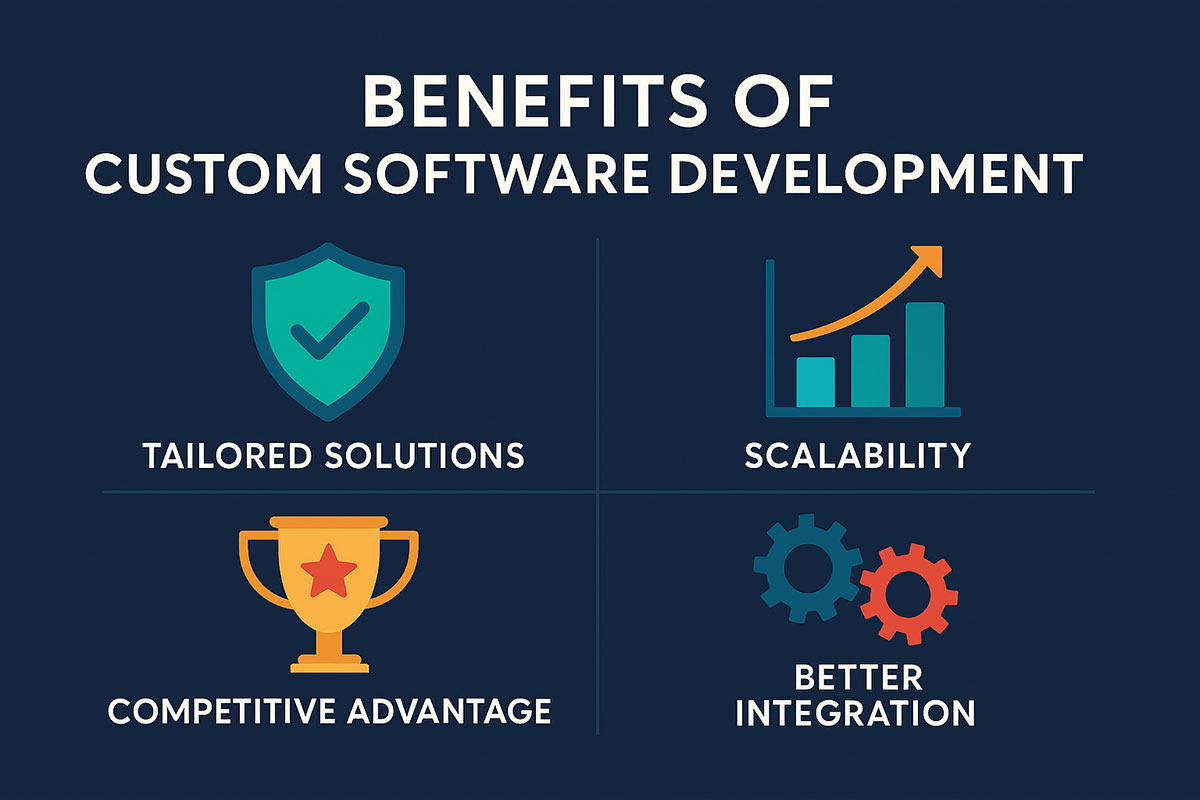
Custom software development empowers organizations to design solutions built around their unique processes, ensuring scalability, efficiency, and a long-term competitive edge.
What is Custom Software Development?
Custom software development is the process of designing, building, and maintaining applications that address the unique workflows and challenges of a specific organization. While off-the-shelf solutions serve a broad audience, custom systems are tailored to align directly with your business objectives. The result is a digital toolset that works for you—not the other way around.
For example, a logistics company may need route optimization, predictive fuel analytics, and real-time tracking. Off-the-shelf software might provide some features, but a custom platform can integrate all of these while adapting to future market changes.
Custom Software vs Off-the-Shelf Solutions
One of the biggest questions decision-makers face is whether to buy ready-made software or invest in building a custom solution. Below is a side-by-side breakdown:
| Criteria | Off-the-Shelf | Custom Software |
|---|---|---|
| Initial Cost | Lower upfront | Higher upfront investment |
| Long-Term Cost | Recurring licensing fees | No licensing fees; scalable cost savings |
| Flexibility | Limited customization | Fully tailored to workflows |
| Integration | Often limited | Built to integrate seamlessly |
| Scalability | Restricted by vendor | Designed for business growth |
| Security | Generic, widely targeted | Customized, advanced protections |
While off-the-shelf tools may seem attractive initially, businesses that outgrow them often face costly migrations later. Custom software development solves this problem by providing a future-ready foundation from the start.
Why Businesses Choose Custom Software
In today’s digital-first economy, businesses face growing pressure to innovate and remain competitive. According to Gartner, global IT spending is projected to exceed $5 trillion in 2024, with a large portion dedicated to digital transformation initiatives. Off-the-shelf software can address some needs, but its limitations quickly become apparent when organizations require specific workflows, industry compliance, or scalability. This is where custom software development comes in.
Key Benefits of Custom Software Development
1. Tailored to Business Needs
Off-the-shelf products often force businesses to adapt their processes to the software. Custom software flips this script, aligning technology with your exact goals. For example, a healthcare clinic may need patient scheduling, telehealth integration, and HIPAA-compliant records. Generic scheduling software won’t cover all these requirements, but a custom solution can.
Case Study – Healthcare: A mid-sized hospital in Ontario adopted custom software to integrate its electronic health record (EHR) with billing, appointment scheduling, and telemedicine. The result was a 25% reduction in patient wait times and an estimated annual savings of $2.1 million through streamlined workflows.
2. Competitive Advantage
Custom software provides a competitive edge by offering functionality your competitors don’t have. When businesses implement bespoke solutions, they often introduce efficiencies or features that are hard to replicate.
Case Study – Retail/eCommerce: A Vancouver-based online retailer implemented a custom recommendation engine tied to customer purchase histories. Within six months, their conversion rates grew by 18%, and average cart values increased by 12%. Off-the-shelf eCommerce platforms rarely offer this level of customization without expensive add-ons.
3. Scalability and Future-Proofing
As businesses grow, their software needs evolve. Off-the-shelf software often struggles to scale with increased demand or shifting industry standards. Custom applications, however, can be built with modular architecture, allowing for future enhancements and integrations.
Case Study – Finance: A Canadian fintech startup designed a custom payment platform that could handle compliance for both Canadian and U.S. markets. When they scaled operations internationally, the system seamlessly integrated additional currency support and regulatory frameworks. As a result, they expanded to three new countries within two years without overhauling their infrastructure.
4. Enhanced Security and Compliance
Security is a growing concern across industries, particularly in sectors like healthcare and finance. Custom software development allows businesses to implement security protocols tailored to their risk profile. By contrast, off-the-shelf software is often a target for cyberattacks due to its widespread use.
For instance, the healthcare industry faces rising cyberattacks: in 2023, over 116 million patient records were exposed in U.S. data breaches. Custom solutions reduce exposure by limiting reliance on widely exploited platforms and embedding compliance standards like HIPAA, GDPR, or PCI DSS directly into the software design.
5. Seamless Integration with Existing Systems
Most businesses operate on a mix of legacy tools, cloud-based applications, and third-party services. Off-the-shelf software often introduces compatibility headaches. Custom software, however, can be built to integrate seamlessly with existing tools such as ERP systems, CRM platforms, or proprietary databases.
Example: A logistics company needed software that integrated GPS fleet tracking with real-time fuel usage and maintenance scheduling. A custom solution enabled them to consolidate data from five different systems, reducing maintenance costs by 22% within the first year.
Industry-Specific Benefits
Healthcare
Healthcare providers rely on accurate, secure, and integrated data systems. Custom healthcare solutions support patient management, billing, compliance, and advanced features like AI-powered diagnostics. This industry particularly benefits from software designed with privacy laws and interoperability in mind.
Finance
Financial institutions deal with sensitive data, regulatory compliance, and high-volume transactions. Custom solutions allow them to innovate with automated fraud detection, blockchain integrations, and personalized customer experiences. This not only builds trust but also drives customer loyalty.
Retail & eCommerce
Retail businesses thrive on customer engagement. Custom solutions enable advanced inventory management, real-time analytics, and personalized marketing. For example, an eCommerce store might use custom dashboards to track abandoned carts and send tailored promotions, boosting revenue without heavy ad spend.
Cost Considerations: Investment vs. ROI
While upfront costs of custom software can be higher, the long-term return on investment is substantial. Businesses often save money on licensing fees, reduce inefficiencies, and unlock new revenue streams. Deloitte reports that 70% of digital transformation projects fail when relying solely on generic software because they don’t align with organizational goals. In contrast, businesses that embrace custom solutions report higher adoption rates and ROI.
Common Mistakes Businesses Make When Choosing Custom Software
While the benefits of custom software are significant, many businesses stumble during the selection or development process. Understanding these pitfalls ensures your investment delivers maximum ROI.
1. Underestimating Total Cost of Ownership
Some companies assume that once development ends, expenses stop. In reality, ongoing maintenance, updates, and scaling need to be budgeted. Ignoring these costs often leads to project abandonment.
2. Lack of Clear Requirements
Businesses sometimes start without fully defining their goals, leaving developers to make assumptions. This results in scope creep, delayed timelines, and inflated budgets. A detailed requirements document avoids this trap.
3. Choosing Price Over Expertise
Opting for the cheapest development vendor may save money upfront but can lead to poor code quality, missed deadlines, and costly rewrites later. Expertise in your industry is more valuable than rock-bottom pricing.
4. Ignoring Scalability
Some businesses build for “right now” without considering future growth. This shortsightedness creates bottlenecks as the company expands. Always prioritize modular, scalable architecture.
5. Neglecting End-User Input
Employees who will use the software daily often have the most valuable insights. Excluding them from design discussions risks creating tools that frustrate rather than empower staff.
Future Trends in Custom Software Development
The custom software landscape continues to evolve, influenced by new technologies and shifting business priorities. Companies planning their digital future should pay close attention to these trends:
- Artificial Intelligence: Predictive analytics, chatbots, and process automation are becoming standard features in bespoke software.
- Low-Code Development: Accelerated development cycles allow faster delivery of custom applications while maintaining flexibility.
- Cloud-Native Applications: Building directly for cloud environments improves scalability, uptime, and cost-efficiency.
- Cybersecurity Integration: Security-first architecture is no longer optional, especially with stricter global regulations.
How to Choose the Right Development Partner
Selecting the right partner is just as important as the decision to invest in custom software itself. Look for:
- Relevant Experience: Ask for case studies in your industry to validate expertise.
- Transparent Process: A structured development cycle with milestones and regular communication is critical.
- Post-Launch Support: Ensure the partner offers ongoing maintenance and scalability planning.
- Cultural Fit: A collaborative approach between teams often predicts long-term project success.
For businesses needing help, consider consulting our IT Consulting services to guide decision-making and ensure long-term ROI.
FAQ Section
Is custom software more expensive than off-the-shelf?
Yes, initial costs are usually higher. However, long-term ROI is often greater because businesses save on licensing fees, boost productivity, and avoid inefficiencies caused by ill-fitting generic software.
How long does custom software development take?
Timelines vary depending on complexity. Small projects can take 3–6 months, while large-scale enterprise platforms may require 12–18 months of development and testing.
Which industries benefit most from custom software?
Industries with complex workflows and strict compliance needs benefit the most, including healthcare, finance, retail/eCommerce, logistics, and education.
Can custom software integrate with existing systems?
Yes. One of the main benefits of custom development is seamless integration with legacy systems, third-party tools, or cloud services.
What if my business grows after the software is built?
Custom applications can be designed with scalability in mind, ensuring your software evolves alongside your business without costly rebuilds.
Unlock Your Business Potential
In today’s competitive marketplace, generic tools no longer provide enough differentiation or efficiency. Custom software development delivers tailored solutions that align with your unique business needs, reduce long-term costs, and position you ahead of competitors. Whether you’re in healthcare, finance, or eCommerce, bespoke applications can future-proof your operations and drive measurable ROI.
At Search Lions SEO, we’ve helped businesses across Canada and the United States harness technology for growth. If you’re ready to explore the possibilities of custom software, it’s time to take the next step toward innovation and efficiency. Let’s build something that transforms the way you work.

