
MVP vs Full App: Choosing the Right Path for Your Business

Every business that enters the digital landscape eventually faces a pivotal question: should you begin with a Minimum Viable Product (MVP) to validate your idea quickly, or commit to a Full Application from the start? This decision is not just about technology—it’s about strategy, investment, growth, and customer perception. Entrepreneurs, startups, and established enterprises alike wrestle with this choice, and the implications can define their success. This guide explores the differences in detail, backed by case studies, frameworks, and industry best practices to help you make the right decision for your business.
The MVP vs Full App decision is about speed, scale, and risk management—choosing the right approach can make or break your product’s success.
What is an MVP (Minimum Viable Product)?
The term MVP was popularized by Eric Ries in The Lean Startup, and it represents more than a stripped-down prototype. An MVP is a disciplined strategy for learning quickly. The goal is not to create a half-baked product, but a focused version that demonstrates value with minimal features. By putting a working product in front of real users as early as possible, businesses validate assumptions, discover pain points, and prioritize features based on actual demand rather than speculation.
For startups with limited budgets, MVPs serve as an efficient risk-mitigation tool. Instead of spending 18 months building a complex product only to find that nobody wants it, teams can test core features in three to six months and pivot if necessary. This lean approach is especially important in industries like SaaS, eCommerce, and mobile applications, where speed and iteration often determine survival.
Characteristics of an MVP
- Core Functionality Only: Focuses on solving the single most important problem.
- Speed-Oriented: Designed to launch quickly and gather insights.
- Iterative: Continuously improved through customer feedback.
- Cost-Effective: Requires less upfront capital than a full-scale build.
Real-World Examples of MVPs
Many billion-dollar companies began with MVPs:
- Dropbox: Validated interest with a short explainer video instead of a product.
- Airbnb: Started with a simple website offering air mattresses in an apartment.
- Twitter (Twttr): Launched as a basic SMS tool for posting short updates.
- UberCab: Tested demand with black cars in San Francisco before scaling.
Each of these companies used MVPs not to cut corners, but to test whether their vision aligned with real market demand. This approach saved time, money, and unnecessary effort while building confidence among investors and early adopters.
Advantages of MVPs
- Validation: Provides proof of demand before scaling.
- Lower Risk: Reduces the financial gamble of unproven ideas.
- Speed: Faster market entry and quicker iteration.
- Investor Appeal: Demonstrates traction with minimal resources.
Challenges of MVPs
- Limited Features: May underwhelm users if expectations aren’t managed.
- Brand Perception: A bare-bones product can look unprofessional.
- Scalability: Some MVPs require rebuilding to support growth.
If you’re planning an MVP launch, pairing it with a strong go-to-market plan is critical. Our digital marketing services can help ensure your product gets visibility with the right audience from day one.
What is a Full Application?
A full application is the complete version of a product designed to meet user expectations comprehensively. Unlike an MVP, a full app doesn’t aim for “just enough”—it delivers a polished, scalable experience from launch. Businesses often choose this path when credibility, brand reputation, or regulatory requirements demand a complete solution.
For example, fintech companies cannot launch incomplete MVPs because security, compliance, and trust are non-negotiable. Similarly, healthcare providers must adhere to regulations like HIPAA before going live. In such industries, a full app is not optional—it’s mandatory.
Characteristics of Full Apps
- Comprehensive Features: Multiple capabilities designed to address varied customer needs.
- Scalable Architecture: Built to handle thousands or millions of users.
- Professional Design: Highly polished UI/UX to inspire trust.
- Monetization Ready: Payment gateways, analytics, and support systems included.
Examples of Full App Launches
- Slack: Launched as a robust collaboration tool, not just a chat MVP.
- Shopify: Offered end-to-end eCommerce capabilities from launch.
- Salesforce: Delivered a complete CRM platform targeting enterprise needs.
Advantages of Full Apps
- Immediate Credibility: Customers trust a polished, feature-complete solution.
- Competitive Edge: Positions you alongside or ahead of competitors.
- Revenue Ready: Full monetization systems in place from launch.
- Scalable: Designed for long-term growth.
Challenges of Full Apps
- High Upfront Cost: Requires significant investment.
- Slower to Market: May take 12–24 months before launch.
- Higher Risk: If assumptions are wrong, sunk costs are substantial.
For companies with strong funding, a full application may be the right move. If you’re building a full app, our web design services can ensure it not only functions well but also delivers exceptional customer experiences.
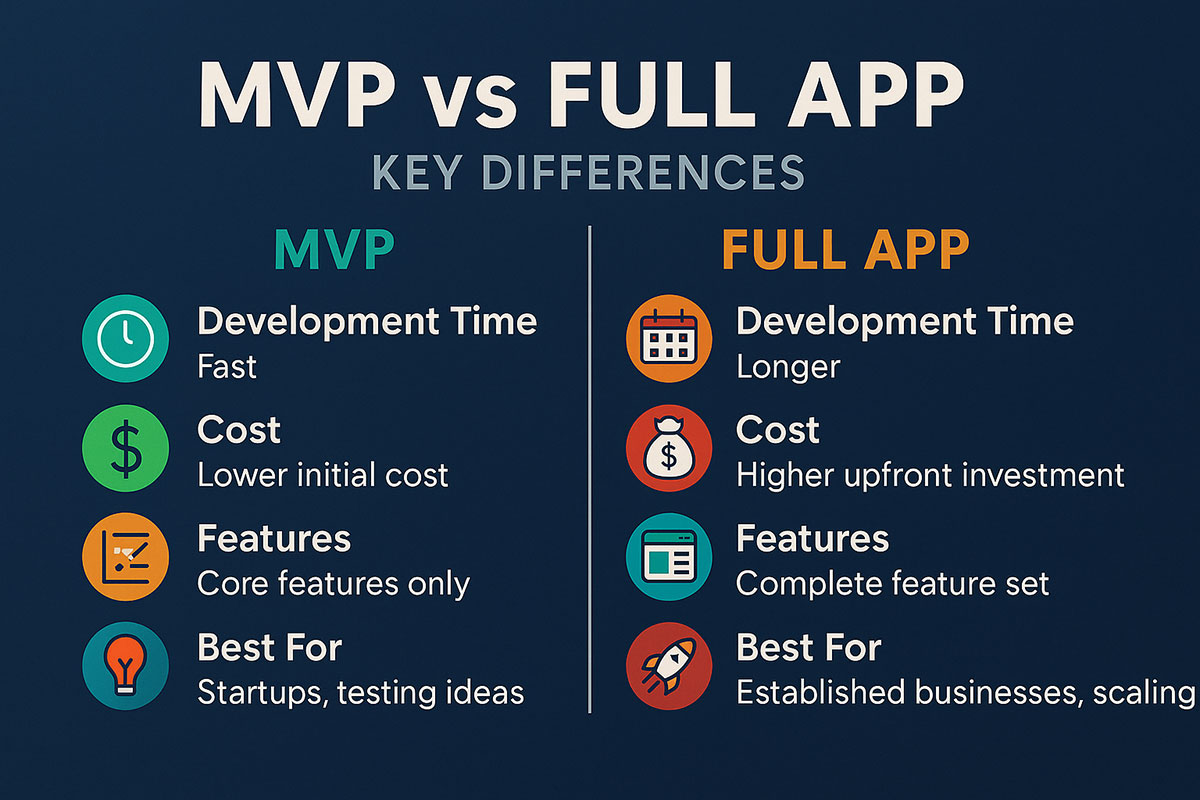
MVP vs Full App: Strategic Comparison
Let’s break down the key differences in detail. This side-by-side comparison highlights the trade-offs between the two approaches:
| Category | MVP | Full App |
|---|---|---|
| Time to Market | 3–6 months, rapid testing and feedback. | 9–24 months, longer build before launch. |
| Cost | Lower upfront investment ($10k–$50k). | Higher upfront investment ($100k+). |
| Risk | Lower financial risk but higher reputational risk if too minimal. | Higher financial risk but stronger market credibility. |
| User Experience | Basic functionality; may frustrate users. | Polished, competitive experience. |
| Flexibility | Easy to pivot. | Harder and costlier to change direction. |
| Scalability | May require rebuilding later. | Built for growth from the start. |
According to National Science Foundation research, iterative approaches like MVPs often improve innovation outcomes by reducing sunk costs. Still, for regulated or competitive industries, full apps may be the only path.
Case Studies & Hybrid Approaches
Some companies succeed by starting with MVPs and evolving into full apps:
- Instagram: Pivoted from Burbn after MVP feedback highlighted photo-sharing.
- Spotify: Started with music streaming basics, scaled into playlists, discovery, and premium features.
Others succeeded by going full from the start:
- Slack: Captured enterprise markets by launching with robust features.
- Salesforce: Offered comprehensive CRM capabilities immediately.
Hybrid strategies are increasingly popular—start lean, then invest in a full app once traction is proven. This balances risk, speed, and scalability.
People Also Ask: MVP vs Full App
Is an MVP always the best starting point?
No. While MVPs are excellent for validation, industries like healthcare and fintech often require full apps to meet compliance and security standards.
Can MVPs damage brand perception?
Yes, if executed poorly. A minimal product without context can appear unfinished. Framing and communication are essential.
How do investors view MVPs?
Most early-stage investors prefer MVPs with traction, while later-stage investors expect more mature, full applications.
Can a full app pivot like an MVP?
Not easily. Full apps are harder to pivot due to sunk costs and complex infrastructure.
Which industries benefit most from MVPs?
Fast-moving sectors like SaaS, eCommerce, and social media benefit most from MVPs, while compliance-heavy industries lean toward full apps.
Take the Next Step
Choosing between an MVP and a full application is a defining moment for your business. An MVP offers speed, flexibility, and validation, while a full app provides polish, scalability, and credibility. In many cases, the best strategy is hybrid: start lean, validate your idea, then scale into a full application once traction is proven.
At Search Lions SEO, we help companies align product development with long-term growth strategies. Whether you’re launching an MVP or scaling a full application, our expertise in SEO, web design, and digital marketing ensures your product doesn’t just launch—it thrives. Ready to take the next step? Let’s build your future together.

