Outsourcing vs In-House Support: Which Model Is Best for Your Business?

When it comes to scaling operations and ensuring efficiency, businesses face a key decision: outsourcing vs in-house support. The choice impacts costs, service quality, and long-term growth. This guide explores the pros, cons, and strategies to help you choose the best approach.
Deciding between outsourcing vs in-house support requires careful consideration of cost, expertise, scalability, and long-term business goals.
What Does Outsourcing vs In-House Support Mean?
In today’s competitive environment, support functions such as IT help desk, customer service, and technical support are critical. Companies can either build an in-house support team, hiring and managing employees directly, or turn to outsourcing technical support services, where third-party providers handle specific functions.
Each model carries implications for cost, flexibility, and quality of service. For small and medium-sized businesses in Canada and the United States, the decision is especially important as resources are limited, and growth often depends on lean yet efficient operations.
The Benefits of Outsourcing IT Support
Outsourcing IT support offers businesses immediate access to specialized expertise without the overhead of hiring a full-time team. According to Deloitte’s Global Outsourcing Survey, 57% of businesses outsource to reduce costs, while 47% do so to gain access to skilled professionals.
Key advantages include:
- Reduced costs compared to maintaining a full in-house department.
- 24/7 availability through global support centers.
- Scalability—support can expand or contract with business needs.
- Access to specialized tools, software, and technical knowledge.
For example, a Vancouver-based eCommerce retailer outsourced its IT help desk and reported a 30% reduction in support costs while achieving faster response times for customer inquiries.
The Disadvantages of In-House IT Support
While in-house support provides direct control, it comes with notable drawbacks. Building and managing a team internally requires significant investment in recruitment, salaries, benefits, and ongoing training. Small businesses often find these expenses prohibitive.
Challenges include:
- High upfront and recurring costs.
- Limited availability outside of standard business hours.
- Difficulty retaining highly skilled professionals in competitive markets.
- Slower scalability compared to outsourcing models.
For instance, a healthcare clinic that relied solely on in-house IT support faced downtime during after-hours emergencies, which delayed patient services and increased costs.
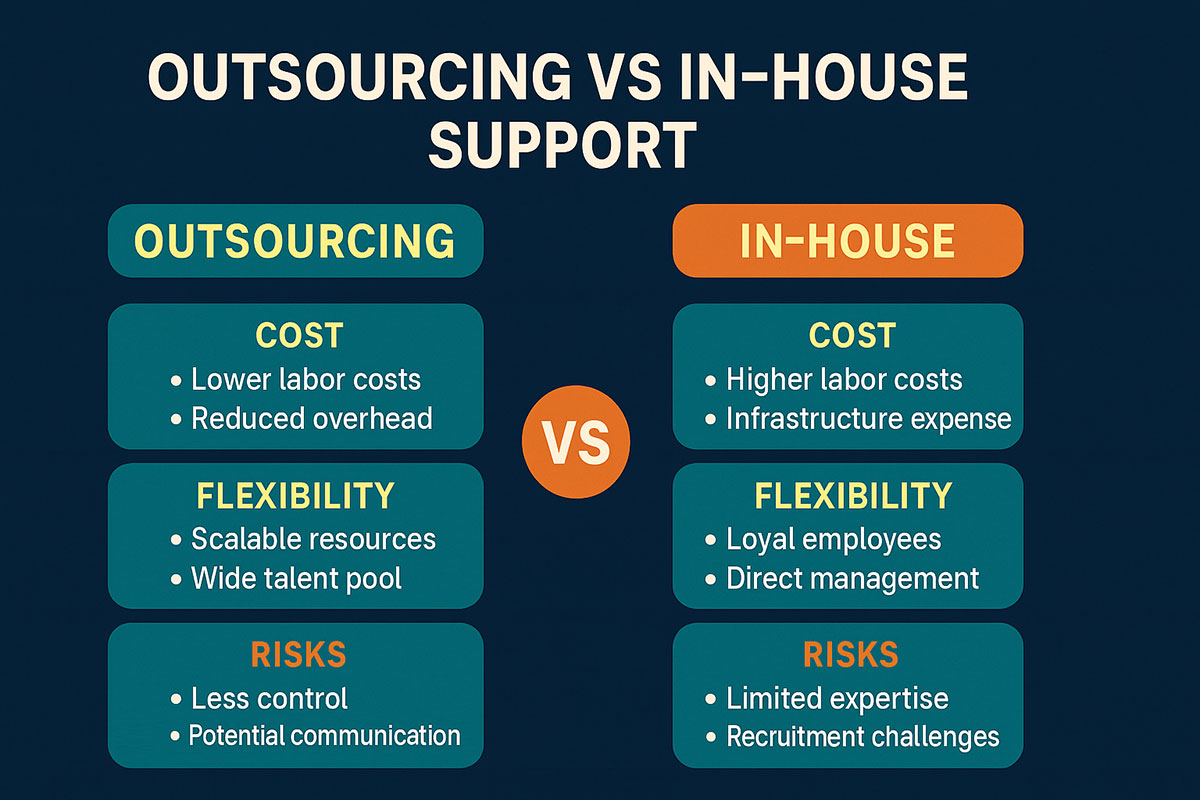
Outsourcing vs In-House Pros and Cons
Ultimately, the decision isn’t black and white. A hybrid model—where companies maintain some internal staff while outsourcing specialized functions—is increasingly popular. Let’s compare the two approaches:
Pros of Outsourcing Support
- Lower costs and predictable pricing models.
- Access to global expertise and technology.
- Faster problem resolution.
Cons of Outsourcing Support
- Less direct oversight of operations.
- Possible communication challenges with offshore teams.
- Dependency on vendor reliability.
Pros of In-House Support
- Direct control over staff and operations.
- Strong alignment with company culture.
- Immediate access to employees on-site.
Cons of In-House Support
- High recruitment and training costs.
- Limited scalability.
- Greater vulnerability during staff turnover.
Cost of Outsourcing vs In-House Support
The financial difference between outsourcing and in-house support can be substantial. Studies show that outsourcing IT help desk services can save businesses up to 40% annually compared to internal operations (Source: Gartner).
A finance firm in Toronto reduced annual IT expenditures from $600,000 to $350,000 by outsourcing technical support while maintaining compliance and service quality. Meanwhile, businesses with complex, regulated environments—such as banking—may choose in-house teams despite higher costs to ensure tighter security and oversight.
Industry-Specific Examples
Healthcare
A hospital network outsourced IT support to manage electronic health records (EHR) compliance. This allowed staff to focus on patient care while external specialists handled system updates and cybersecurity monitoring.
Finance
A mid-sized accounting firm used in-house IT support for daily operations but outsourced penetration testing and cybersecurity monitoring to maintain compliance with financial regulations.
Retail & eCommerce
A Canadian eCommerce company outsourced customer service support, enabling 24/7 assistance during peak shopping seasons. This boosted customer satisfaction scores by 25% while keeping labor costs steady.
Small Business IT Support Outsourcing
For small businesses, outsourcing IT help desk vs in-house support often comes down to cost and flexibility. Startups can quickly access technical expertise without investing heavily in recruitment or infrastructure. This is especially critical when scaling fast or entering competitive markets.
For startups in Vancouver, partnering with outsourced providers often means redirecting savings into growth activities such as digital marketing and web design, fueling long-term success.
Common Mistakes Businesses Make When Choosing Outsourcing vs In-House Support
- Focusing only on cost without considering long-term scalability.
- Failing to define clear service-level agreements (SLAs) with vendors.
- Neglecting cybersecurity requirements when outsourcing.
- Assuming in-house teams guarantee better quality without analyzing performance.
FAQ: Outsourcing vs In-House Support
What is the main difference between outsourcing and in-house support?
Outsourcing involves hiring external providers to manage support services, while in-house support means employing internal staff to handle those tasks directly.
Is outsourcing IT support cheaper than in-house?
Yes, outsourcing is typically more cost-effective. Many businesses save 30–40% annually compared to managing an in-house support team.
What are the risks of outsourcing customer service?
Risks include reduced oversight, cultural or communication barriers, and dependency on third-party reliability. These can be mitigated with strong vendor contracts.
When should startups consider in-house support?
Startups often begin with outsourcing for flexibility. In-house support becomes valuable when a business grows large enough to require dedicated, company-aligned teams.
Can a hybrid support model work?
Yes, many businesses succeed with hybrid models, keeping core tasks in-house while outsourcing specialized services such as cybersecurity or customer service overflow.
Ready to Transform Your Business?
Whether you’re leaning toward outsourcing or building an in-house team, making the right choice requires careful evaluation of cost, expertise, and scalability. At Search Lions SEO, headquartered in Vancouver and serving clients across Canada and the U.S., we help businesses optimize operations and achieve sustainable growth. Explore how our IT consulting and outsourced customer service solutions can give you a competitive edge.