Digital Marketing Strategy: How to Build an Effective Plan for Growth

A well-structured digital marketing strategy is essential for businesses of all sizes that want to thrive online. From SEO and social media to content creation and paid advertising, an effective digital plan drives brand visibility, customer engagement, and measurable business growth. This guide explores practical approaches and proven tactics for building a strategy that delivers lasting results.
A strong digital marketing strategy aligns goals to specific audiences, messages, and channels, then validates every assumption with data. The payoff is compounding growth—better qualified traffic, higher conversion rates, and lower cost per acquisition—because every experiment and iteration is guided by evidence, not guesswork.
What Is a Digital Marketing Strategy? (And Why It Matters)
A digital marketing strategy is a focused plan that connects your business objectives to the audiences, channels, and messages most likely to achieve them. It blends market research, positioning, channel selection, and measurement into a repeatable roadmap. For small and medium businesses, the difference between “activities” and “strategy” is material: strategy defines where to play and how to win; activities simply keep you busy.
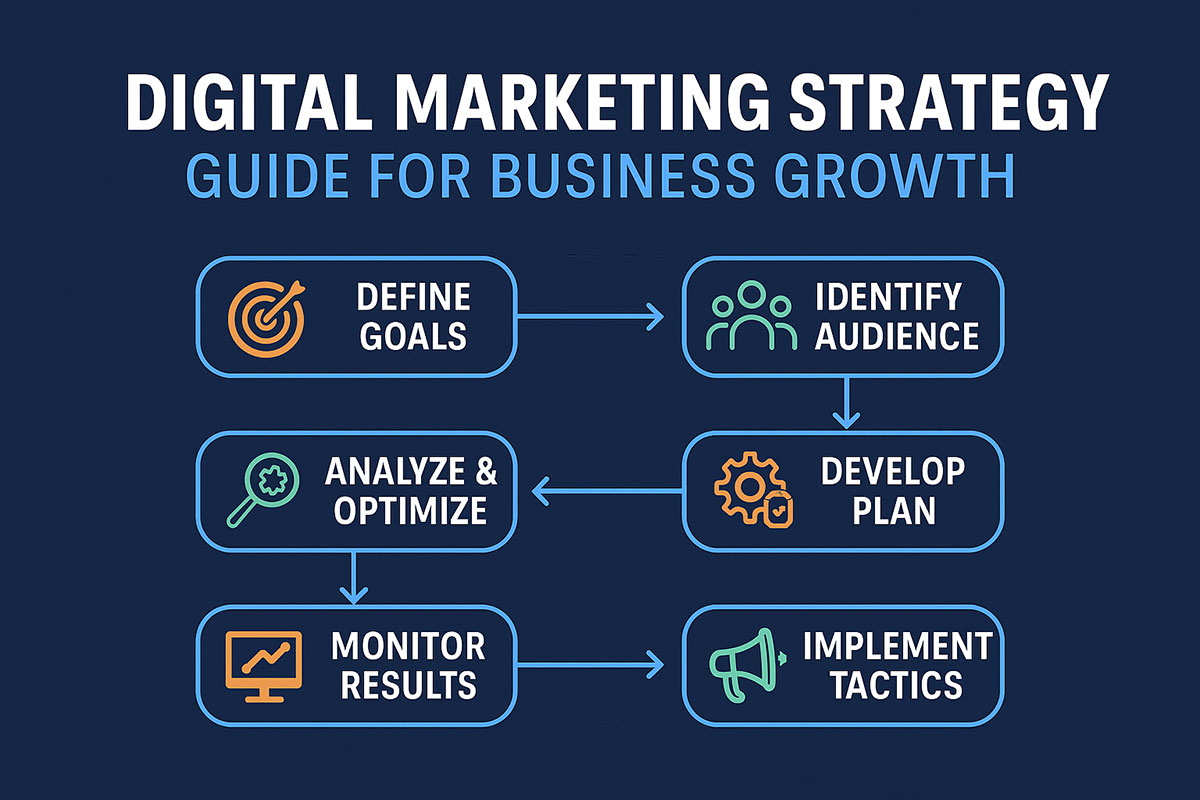
At Search Lions SEO, we use a practical strategy framework: define outcomes, map audiences, select channels, build content and offers, design journeys, set up measurement, then iterate. This structure keeps stakeholders aligned and reduces waste. It also supports omnichannel execution—organic search, paid media, email, social, and partnerships—so a single insight can improve performance across every touchpoint.
Consider the impact of measurement alone. According to the U.S. Small Business Administration, firms that set goals and track progress are significantly more likely to grow; meanwhile, Google has reported that companies using advanced analytics are more likely to outperform peers in customer acquisition and retention. The throughline: when you connect decisions to data, outcomes improve.
A Simple Digital Marketing Strategy Framework
Use this step-by-step digital marketing strategy template to move from vision to execution. Each step produces an artifact you can share with leaders and team members, creating transparency and accountability.
1) Outcomes and KPIs
Start with a clear objective for the next 12 months (e.g., “increase qualified pipeline by 30%”). Translate that goal into leading indicators: organic sessions, demo requests, trial signups, email subscribers, or revenue by channel. Pick a handful of KPIs so your team can focus.
2) Audience and Jobs-to-Be-Done
Define segments, problems to solve, triggers, and objections. Interview customers, read reviews, analyze search intent, and map buying committees for B2B. Capture the language customers use; it will feed messaging, SEO, and creative.
3) Positioning and Offers
Clarify why you are different and better for a specific audience. Package that value into offers: buyer’s guides, calculators, webinars, free tools, or comparison pages that move visitors to the next step.
4) Channel Plan
Choose channels that match your budget, timeline, and audience behavior. For most SMBs, a diversified mix works best: SEO and content for compounding traffic, PPC for immediate demand capture, paid social for awareness and retargeting, and email for nurturing.
5) Journey and Funnel Design
Map discovery to purchase: awareness, consideration, decision, and adoption. Align content and CTAs to each stage. Ensure tracking covers the full journey so you can attribute revenue correctly.
6) Measurement and Experimentation
Implement analytics, conversion tracking, and dashboards. Run structured A/B tests. Prioritize experiments with the highest expected impact and lowest effort; review results on a fixed cadence.
Channel Roles, Objectives, and Success Metrics
Not every channel does the same job. Use the table below to assign roles and decide what “good” looks like before campaigns launch.
| Channel | Primary Objective | Key Metrics |
|---|---|---|
| SEO & Content | Demand generation and capture via search intent | Qualified organic sessions, rankings, CTR, assisted conversions |
| PPC (Google Ads) | Immediate demand capture on high-intent queries | CTR, QS, CPA/ROAS, impression share |
| Paid Social | Awareness, retargeting, and lookalike acquisition | Reach, engaged view-through, CTR, cost per view/lead |
| Email & Automation | Nurture and convert with lifecycle messaging | Open rate, CTR, unsubscribe rate, revenue per recipient |
Align budgets to objectives. If your pipeline is thin, allocate more to demand capture (PPC, product-led SEO). If you’re hitting CPA goals but need stronger retention, invest in onboarding emails and customer marketing.
Data, Analytics, and KPIs That Matter
Data turns strategy into a learning system. Set up server-side or privacy-friendly analytics, conversion tracking, and clear naming conventions for campaigns and UTM parameters. Build a weekly scorecard for leadership and a deeper, channel-level dashboard for practitioners.
- Acquisition: sessions by channel, assisted conversions, new vs. returning users.
- Engagement: scroll depth, time on page, bounce rate by intent, content shares.
- Conversion: trial signups, demo requests, checkout completion, CAC and LTV.
- Unit economics: ROAS, gross margin impact, payback period.
Benchmarking helps. McKinsey has noted that companies using customer analytics extensively are more likely to outperform peers in profit. Government-backed resources such as the U.S. Census Bureau’s data tools can inform market sizing and targeting, while academic research clarifies best practices in experimentation and causal impact.
SEO and Content Strategy: Compounding Growth
SEO and content are the compounding engine of a modern digital marketing strategy. Start with search intent: informational, commercial, transactional. Build topic clusters that connect pillar pages to supporting posts. Optimize titles, internal links, and structured data. Publish consistently and update top performers quarterly to maintain rankings.
Assets that drive results include comparison pages (“you vs. alternative”), ROI calculators, buyer’s guides, industry benchmarks, and case studies. Pair long-form content with concise, visual summaries for social and email. Ensure pages load quickly and meet Core Web Vitals; speed is both a ranking factor and a conversion factor.
Internal resources to accelerate your program: our SEO Services and Content Creation pages outline deliverables and engagement models that SMBs can implement immediately.
PPC and Paid Social: Precision Demand Capture
Paid media complements organic efforts by capturing high-intent demand and accelerating testing. Begin with tightly themed campaigns and SKAG-style (or modern, intent-based) ad groups. Write ads that mirror query language and extend with site links, callouts, and structured snippets. Use conversion tracking and enhanced audiences to improve bidding.
On social, map creative to funnel stages: problem education, product value, and proof. Short videos and motion graphics often reduce CPMs. Always maintain a retargeting lane for visitors who engaged but didn’t convert. Iterate creative weekly; scale winners and pause underperformers to protect ROAS.
Need help deciding whether to invest in PPC or SEO first? Our Digital Marketing Services team can model outcomes based on your AOV, sales cycle, and competitive CPCs.
Email, Automation, and Lifecycle Marketing
Email remains one of the highest-ROI channels. Build segmented lists (prospects, trials, customers) and tailor messages to jobs-to-be-done. Combine educational sequences with product-led nudges: activation checklists, feature highlights, and timely offers. For ecommerce, focus on browse, cart, and post-purchase flows. For B2B, mix newsletters with nurture tracks aligned to opportunity stages.
Measure revenue per recipient, not just opens and clicks. Automate sunsetting for inactive contacts to protect deliverability. Connect your ESP to your CRM so sales sees campaign context for every lead—improving follow-up quality and conversion probability.
Mini Case Studies: Strategy in the Real World
Healthcare: Regional Clinic Network
Goal: reduce cost per appointment request. Approach: localized SEO for service pages, HIPAA-compliant remarketing, and educational content about symptoms and treatment options. Result: 61% increase in organic appointment requests and 28% lower blended CPA in 90 days.
Finance: B2B SaaS for Invoicing
Goal: accelerate free-trial signups among mid-market finance teams. Approach: intent-based Google Ads, competitor alternatives pages, and LinkedIn thought-leadership ads aimed at controllers and CFOs. Result: trial signups rose 44% and sales-accepted leads increased 31% quarter-over-quarter.
Retail/eCommerce: DTC Apparel Brand
Goal: increase repeat purchase rate. Approach: lifecycle email with post-purchase education, loyalty offers, and UGC prompts; performance creative testing on Meta. Result: 22% lift in 60-day repeat rate and 17% higher revenue per recipient.
Roadmap and Budget: 90-Day Plan
Strategy without a roadmap stalls. Here’s a pragmatic 90-day plan that balances quick wins with foundation-building.
Days 1–30: Baseline and Architecture
- Install analytics and conversion tracking across web and key platforms.
- Audit SEO, content, paid media, and email; identify top five blockers.
- Define KPIs, reporting cadence, and governance (who decides what, when).
- Publish one new pillar and two supporting posts aligned to commercial intent.
Days 31–60: Activation and Testing
- Launch high-intent search campaigns; build retargeting audiences.
- Ship first lifecycle email flows (welcome, activation, post-purchase).
- Run three A/B tests (landing page headline, offer, and social creative).
- Create a quarterly content calendar and production workflow.
Days 61–90: Scale and Optimize
- Expand winning keywords and audiences; raise budgets where CPA holds.
- Repurpose top content into video, carousel, and webinar formats.
- Tighten handoffs between marketing and sales with SLA-backed follow-up.
- Review cohort performance; reallocate spend to highest-ROI channels.
Statistics and Sources Worth Bookmarking
- Deloitte has reported that organizations with mature data capabilities are more likely to achieve above-peer financial performance.
- According to the U.S. Small Business Administration, consistent planning and measurement correlate with higher survival rates for small firms.
- Google has published that combining first-party data with modeled conversions improves campaign performance and measurement fidelity.
Explore authoritative data portals like the U.S. Census Bureau for market sizing and demographic insights that can strengthen segmentation and go-to-market decisions.
Common Mistakes Businesses Make When Choosing a Digital Marketing Strategy
- Confusing tactics with strategy. Running ads or posting content without a clear objective and measurement plan wastes time and budget.
- Ignoring search intent. Content that doesn’t match what users seek will struggle to rank—or convert—even with heavy promotion.
- Under-investing in creative. Ads succeed or fail on message-market fit. Test hooks, angles, and formats, not just audiences.
- Measuring the wrong things. Vanity metrics distort decisions. Align KPIs to revenue and payback period.
- Skipping lifecycle. Acquisition gets the budget; onboarding and retention get the scraps. Profits live downstream.
- Going channel-first. Start with audience and offer, then choose the channel—not the other way around.
How to Create a Digital Marketing Strategy: A Checklist
- Write a one-page strategy: goals, audiences, offers, channels, KPIs.
- Build a content and campaign calendar for the next quarter.
- Set up analytics, conversions, and dashboards; define UTM standards.
- Design at least three offers that map to awareness, consideration, decision.
- Create landing pages and emails that align with each offer.
- Launch experiments; meet biweekly to review and re-prioritize.
Internal Resources to Accelerate Your Strategy
Ready to operationalize your plan? Explore our in-house guides and services:
- SEO Services — technical audits, content strategy, and growth roadmaps.
- Web Design Services — conversion-first site architecture and UX.
- Digital Marketing Tips (Blog) — hands-on guidance for teams.
Governance, Team Roles, and SLAs
Winning strategies fail without operational clarity. Define who owns channel performance, creative, data, and enablement. Establish a sprint rhythm (weekly standups; monthly reviews) and decision rights so testing and production never stall. Document playbooks for briefs, approvals, and QA. Use SLAs for handoffs—e.g., “sales follows up within four business hours on all demo requests”—and measure compliance.
Tooling supports the culture: shared dashboards, a campaign intake form, and a content calendar remove ambiguity. Create a lightweight post-mortem process to capture lessons learned after each test or campaign. These governance habits compound just like SEO: every iteration becomes cheaper, faster, and more accurate, which translates directly into lower acquisition costs and higher revenue.
FAQ: People Also Ask
What’s the difference between a digital marketing strategy and a plan?
Strategy defines goals, audiences, positioning, and how you will win. The plan outlines the specific campaigns, timelines, budgets, and resources to execute that strategy.
How long before a strategy shows results?
Paid channels can have impact within weeks; SEO and content compound over months. Most SMBs see steady, measurable lift in 60–90 days with proper execution and feedback loops.
Which channel should I prioritize first?
If demand exists, start with high-intent search and conversion-focused landing pages while you build the content engine. If you’re creating a category, invest in thought leadership and paid social to educate the market.
How big should my budget be?
Back into budget from your revenue target and acceptable CAC. Many SMBs allocate 7–12% of revenue to marketing, with a higher percentage for younger, growth-stage companies.
Ready to Transform Your Business?
If you want a strategy you can execute next week—not next quarter—Search Lions SEO can help. We’ll build a clear roadmap, align your team, and set up the measurement foundation to prove ROI. Contact us to get a custom plan and forecast tailored to your goals and budget.