
How to Close the Digital Skills Gap: Solutions for Businesses in Canada and the U.S.

The digital economy demands new skills at an unprecedented pace. For many organizations, how to close the digital skills gap is now a critical question. From upskilling current employees to adopting corporate training programs, finding practical solutions is essential to stay competitive.
Closing the digital skills gap requires a combination of workforce training, reskilling, and innovative strategies to prepare employees for digital transformation.
The Importance of Digital Skills in the Workplace
Digital literacy has moved beyond being a “nice-to-have” to becoming a core business requirement. From small eCommerce shops to multinational corporations, employees need to adapt to cloud computing, data analytics, automation, and AI. A recent World Economic Forum report found that 50% of all employees will need reskilling by 2025 due to technological advances.
For small and medium-sized businesses, addressing the digital skills gap is often harder, as resources are limited. However, failing to act can mean losing competitiveness, productivity, and even talent to competitors who offer better training and career growth opportunities.
For example, a retail company in Vancouver invested in digital marketing workshops for its staff. Within six months, the company improved online sales by 22%, demonstrating the importance of digital skills in the workplace.
Digital Skills Gap in Canada and the United States
The digital skills gap in Canada and the digital skills gap in the U.S. has been recognized at national levels. In Canada, the Information and Communications Technology Council (ICTC) estimates that 250,000 new digitally skilled workers will be needed by 2025. Meanwhile, the U.S. Bureau of Labor Statistics projects more than 400,000 new IT-related roles over the next decade.
This shortage impacts industries such as healthcare, finance, and eCommerce, where digital transformation is most urgent. In finance, for example, employees need cybersecurity and data analysis skills to keep up with both customer demand and regulatory compliance. In healthcare, digital tools like electronic health records and telemedicine require specialized technical training.
Workforce Digital Upskilling Strategies
One of the most effective digital skills gap solutions is implementing structured workforce digital upskilling strategies. These strategies focus on reskilling current employees instead of relying solely on external hiring, which can be costly and time-consuming.
Key Strategies Include:
- Offering internal workshops and training programs to close the digital skills gap.
- Encouraging employees to pursue online certifications in areas like cloud computing, data analysis, and digital marketing.
- Creating mentorship programs where experienced employees train colleagues on new tools.
Case Study: A mid-sized Canadian healthcare provider launched monthly training sessions for its staff in cybersecurity and data management. This initiative reduced system downtime by 30% and increased staff confidence in handling sensitive patient data.
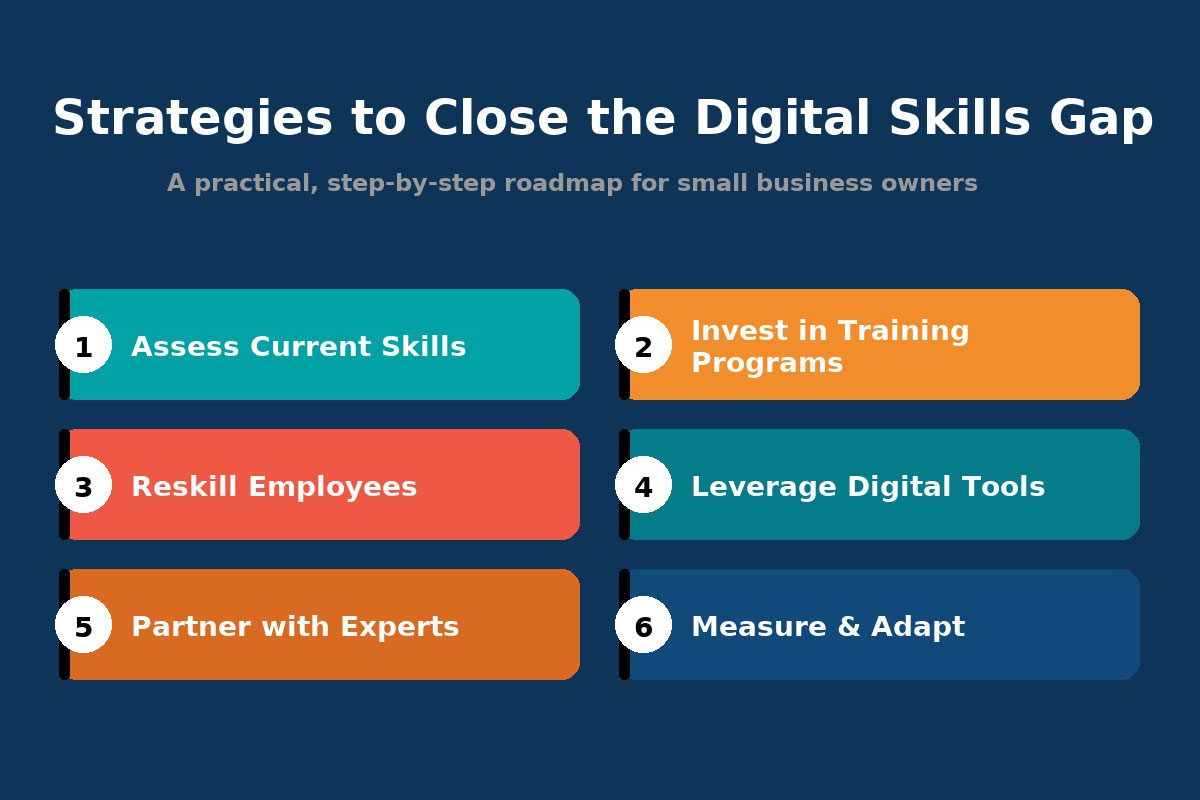
Training Programs to Close the Digital Skills Gap
Companies can leverage both external and internal training programs to close the digital skills gap. Universities, community colleges, and government-backed initiatives offer subsidized training that businesses can integrate into their workforce development plans.
Government initiatives such as the U.S. Department of Labor’s apprenticeship programs and Canada’s Digital Skills for Youth Program provide funding and resources to support business-led training. These programs not only improve employee performance but also help attract younger workers who prioritize skill-building opportunities in their career choices.
For eCommerce businesses, investing in training employees on tools like Shopify, Google Analytics, and digital advertising directly translates into improved marketing performance. This ties closely to services like digital marketing and web design, where strong digital skills can make or break online growth strategies.
Reskilling Employees for Digital Roles
Reskilling involves retraining employees to move into new digital roles. This strategy is particularly effective when organizations are experiencing workforce shifts due to automation. For example, clerical staff can be retrained in data entry automation, CRM management, or even social media operations.
Case Study: A financial services firm in Toronto reskilled part of its administrative workforce into entry-level cybersecurity positions. This reduced hiring costs by 40% and addressed a critical shortage of cybersecurity professionals in-house.
The Future of Work and Digital Skills
The future of work and digital skills is characterized by constant change. Cloud technologies, AI, and machine learning are no longer niche but core to business operations. Employees who lack training will find it harder to keep up, and companies that fail to adapt risk being left behind.
A McKinsey study found that 87% of companies worldwide face or expect to face skill gaps within the next five years. This means bridging the digital skills gap must become a strategic priority, not just an HR initiative.
Corporate Training to Reduce the Digital Skills Gap
Corporate training to reduce the digital skills gap has proven to deliver measurable ROI. Companies investing in continuous training see improved employee retention, innovation, and productivity. Training can be delivered through on-demand eLearning platforms, in-person bootcamps, or hybrid models.
Case Study: A Vancouver-based eCommerce company used corporate training to improve staff skills in SEO and content creation. This led to a 45% increase in organic search traffic within a year, demonstrating how reskilling can directly support SEO strategies.
Common Mistakes Businesses Make When Choosing How to Close the Digital Skills Gap
- Focusing only on technical skills without addressing soft skills like communication and problem-solving.
- Assuming younger employees are already digitally fluent and skipping training for them.
- Failing to measure the ROI of training initiatives.
- Relying solely on external hiring rather than reskilling current employees.
FAQ: How to Close the Digital Skills Gap
What is the digital skills gap?
The digital skills gap is the mismatch between the digital skills businesses need and the skills employees currently have.
How can businesses close the digital skills gap?
Businesses can close the gap by investing in workforce training, reskilling, and leveraging government-supported initiatives.
Why is closing the digital skills gap important?
Without digital skills, businesses risk losing productivity, competitiveness, and the ability to adapt to digital transformation.
Which industries are most affected by the digital skills gap?
Healthcare, finance, and eCommerce are heavily impacted due to their reliance on digital technologies and compliance requirements.
What role do governments play in bridging the digital skills gap?
Governments provide funding, training programs, and partnerships with businesses to support workforce development in digital skills.
Ready to Transform Your Workforce?
Closing the digital skills gap is no longer optional—it’s essential for future growth. At Search Lions SEO, headquartered in Vancouver and serving clients across Canada and the U.S., we help organizations integrate digital training, reskilling, and strategy development into their growth plans. Discover how our corporate training services and IT consulting solutions can help you prepare your team for the digital future.

